
 By Cyril Kimbi
Almost every study guide assumes a constant internet connection and mains electricity. For a large share of candidates in Cameroon neither holds, and the usual advice — watch this video, use this app, look it up — quietly assumes conditions that are not there. The fix is not to study less. It is to sequence the work so the connected part and the thinking part are separated.
The principle: batch the connected work
The single most costly habit is studying with the connection open, looking things up as you go. It burns data, it fails when the connection does, and it invites the drift from a search to everything else on the phone.
Instead, keep a running list during offline work of everything you need to fetch: a paper, a scheme, a definition, a diagram. Then fetch the whole list at once, when you have a good connection. One twenty-minute session at a cyber cafe, at school, or wherever signal is reliable, can supply a fortnight of offline work.
This has a second benefit that nobody expects: it makes you finish the thinking before reaching for an answer. Writing “I could not do part (b)” and moving on, then checking later, is retrieval practice. Looking it up immediately is not.
Build a local library once
Aim to hold, on the device or on paper, everything you will need for a full revision cycle:
- Past papers for every subject, as many years as you can get.
- Marking schemes for the same papers — more important than the papers, and more often forgotten.
- The syllabus for each subject, so you know what is examinable.
- Your own notes and worked-example log.
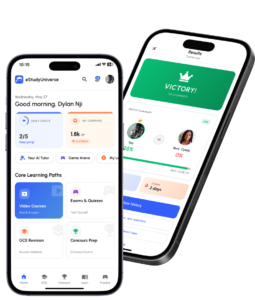
The past questions library and the syllabus guide cover the first three, and the eStudyUniverse app stores papers for offline use specifically so the fetching happens once.
A practical note on storage: name files so you can find them without a search index — Subject-Year-Paper — and keep a second copy somewhere. A phone that is lost or wiped a month before the exam is a real risk, and one that is entirely preventable with a memory card or a copy on someone else’s device.
Study methods that need no connection at all
The techniques with the strongest evidence behind them are, conveniently, the least dependent on technology.
Retrieval practice needs a blank page and a pen. Read a section, close it, write down everything you can remember, then check. The gaps are your revision list.
Timed past papers need a paper and a clock. This is the highest-value activity in any revision programme and it requires nothing else.
Strict self-marking needs the marking scheme you already downloaded. Marking your own work honestly against it produces a precise list of your recurring losses.
Explaining aloud needs another person, or no one. Teaching a topic from memory exposes gaps immediately, at the exact point the explanation becomes vague.
Notice that none of these is a compromise. They are what the evidence supports for everyone; the connection was never the important part. The study methods guide covers why.
Working around power
A few things reduce the disruption more than they sound like they should:
- Do the screen-dependent work when charged, and paper work when not. Keep a printed or handwritten queue for exactly this.
- Print or copy the highest-value material — the papers you will do repeatedly. Paper does not run out of battery.
- Charge on a schedule, not when the device is empty. Being at 5 percent when the power comes on wastes the window.
- Keep a wall summary sheet. One page per subject of the things you keep forgetting, visible without opening anything.
- Study in daylight where you can. Shifting an hour earlier is cheaper than any lighting solution.
Turning shared access into an advantage
Where a device or connection is shared between siblings or a study group, the usual response is to divide the time. A better one is to divide the fetching.
Four candidates each download a different subject’s papers and schemes, then share the files offline. Each person has spent a quarter of the data and holds the whole library. The same logic applies to a study group: one person fetches, everyone works.
Group work is also the one study method that improves under these conditions rather than despite them. Explaining a topic aloud to three other people requires nothing but the four of you, and it is among the most effective uses of an hour.
Frequently asked questions
Can I really prepare properly without regular internet?
Yes. The techniques that work best — retrieval practice, timed papers, strict self-marking — need paper and a clock. The connection is for fetching material, once.
How much material should I download at a time?
A full revision cycle’s worth: every paper and marking scheme you intend to work through, plus the syllabus.
Is it better to print or keep files on a phone?
Print the papers you will do repeatedly. Keep the rest digital, with a backup copy elsewhere.
What if I lose my phone before the exam?
This is why a second copy matters — a memory card, a friend’s device, or printed papers. Assume the device can disappear.
Does studying offline put me at a disadvantage?
Not for the work itself. It only becomes a disadvantage if you rely on looking things up instead of retrieving them, which is the weaker method anyway.