

 By Cyril Kimbi and Keng Elson
Cameroonian students need more than PDF downloads: they need offline access, worked solutions, timed practice, and help when stuck at 11pm before mocks. eStudyUniverse is a Cameroon-focused GCE and concours preparation platform built for exactly that problem.
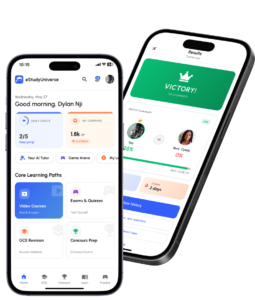
AI Tutor + offline GCE papers in eStudyUniverse


Core App Features for GCE Students
- AI Tutor: step-by-step explanations with LaTeX for Maths and Physics
- Practice Center: topic drills sorted by difficulty
- Offline mode: download on wifi, study without data
- the answer review: 7, 30, and 90-day weak topic trends
- 1v1 Challenges: compete with classmates on the same questions
- Mobile Money: MTN MoMo and Orange Money for premium features
Who Should Download the App?
Form 5 and Upper Sixth students preparing for GCE, resit candidates, and concours competitors who already use free web PDFs but lose hours searching for solutions.
Visit the app landing page for store links.
Comparing eStudyUniverse to PDF-Only Sites
PDF archives give you files. eStudyUniverse gives you files plus marking workflow, AI explanations, topic drills, and score tracking. Students who only download PDFs often lose hours searching for solutions. Students using the app fix errors within 24 hours because AI Tutor and Practice Center are one tap away.
Feature Deep Dive: the answer review
Analytics aggregates lost marks by topic over 7, 30, and 90 days. Use it to decide whether your week should focus on calculus, organic Chemistry, or comprehension — data instead of guesswork.
Feature Deep Dive: 1v1 Challenges
Challenge classmates on the same past paper question. Competition increases accountability during boring revision weeks before mocks.
Getting Started in Three Steps
Install from Google Play or App Store. Download your weakest subject on wifi. Sit one timed paper and review lost marks with AI Tutor the same evening.
Security and Privacy
eStudyUniverse does not sell candidate data or publish unofficial grade lists. Payments via MTN MoMo and Orange Money use standard mobile money security. Download only from official store links on the app landing page.
Support When You Are Stuck
AI Tutor handles mathematics, physics, and chemistry steps. WhatsApp community provides peer support for navigation questions. Contact page handles billing and content correction requests.
Transition from Web PDFs to the App
Many students start on the website and migrate to the app for offline mode. Sign in with the same account to sync downloads and the answer review history.
Science students should cross-link revision across Biology A Level, Physics A Level, Chemistry A Level, and Mathematics A Level hubs on eStudyUniverse.
Integrating School, Home, and App Revision
Use school hours for teacher explanations and lab practicals. Use home sessions for timed papers downloaded on wifi. Use the app for AI Tutor on questions you missed after marking. Never skip marking — unmarked papers teach almost nothing.
Running the App on a Low-End Phone and a Small Data Budget
Most students in Cameroon are not studying on a new phone with unlimited data. They are on a shared or entry-level Android device with limited storage and a data bundle that has to last the week. The app is built for exactly this situation, but a few habits make the difference between it working well and it becoming a frustration.
Download everything on wifi, once. The single most important habit is treating wifi access as a downloading opportunity rather than a browsing one. When you reach a school library, a cybercafe, or a relative with a connection, download the full set of papers for your subjects rather than the one you need that evening. Once downloaded, they open offline indefinitely, and your data bundle is never spent on the same paper twice.
Download by subject, not by curiosity. Storage fills fastest when students download broadly. Take the subjects you are actually sitting, complete them fully, and only then add extras. A focused library of your own subjects takes a fraction of the space of an unfocused one.
Clear space before a download session, not during one. Photographs and videos, not study material, are what usually fill a phone. Move them to an SD card or a computer before you go to wifi, so the download session is not spent deleting files under time pressure.
Study offline by default. Turn mobile data off while revising. It protects the bundle, and it removes the notifications that break concentration during a timed paper. The papers, your progress, and your practice history all remain available without a connection.
Manage the battery around study blocks. Power cuts during the rainy season make evening revision unpredictable. Charge during the day whenever supply is stable, lower screen brightness while reading, and keep a timed paper session short enough to complete on the charge you have. A power bank shared between siblings costs less than repeated lost sessions.
Sync when you next reach a connection. Practice results recorded offline update your analytics once the app reconnects, so your progress tracking stays accurate even if most of your revision happens with data switched off entirely.
Used this way, a modest phone and one wifi session a week are enough to run a full revision programme.
Sharing One Device Between Siblings
In many households one phone serves two or three students, and the arrangement works if the study time is scheduled rather than negotiated nightly.
Give each student a fixed block. A timed paper cannot be interrupted halfway and still measure anything. Agree blocks long enough to complete a full paper, and treat them as fixed the way a class period is fixed.
Download for everyone in the same wifi session. When the device reaches a connection, pull the papers for every subject any sibling is sitting. It costs one session instead of three.
Keep progress separate. Analytics are only useful if they reflect one student. Where siblings share a device, agree who is signed in during each block so improvement trends stay meaningful rather than blended.
Put the examination candidate first. In a year when one sibling sits GCE and the others do not, the evening blocks belong to the candidate. Families that decide this in advance argue about it far less in May.
Where an App Actually Changes the 2026 Numbers
The 2026 GCE results, released on 21 August 2026, contain one statistic that says more about study resources than any product description could. At Advanced Level, school candidates passed at 69.95 percent. External candidates passed at 42.55 percent.
That gap of more than twenty seven points is the problem worth solving. It is not a difference in ability. It is a difference in access to past papers, marking guides, timed practice, mock discipline, and someone to ask when a topic will not resolve.
Those are exactly the things an app can supply to a candidate who has no school behind them, and they are the reason to judge any study tool by whether it closes that specific list rather than by how it looks.
Past papers, downloaded once. A private candidate with the full set on their phone has the same raw material a school candidate has in a departmental cupboard.
Timed practice with a record. Sitting papers against the clock and keeping the scores is what a school mock provides. Doing it alone without recording anything is not the same exercise.
Something to ask. The AI Tutor exists to replace the teacher you can catch after class. Used for method rather than for answers, it removes the fortnight a blocked topic otherwise costs.
Progress you can see. the answer review answers the question a private candidate cannot otherwise answer, which is whether the plan is working while there is still time to change it.
Which Subjects to Load First
The 2026 subject results give a clear order for a candidate deciding what to download first. Pure Mathematics with Statistics passed at 21.14 percent, Information and Communication Technology at 34.04 percent, Economics at 40.13 percent, and Chemistry at 48.45 percent. Religious Studies passed at 86.57 percent and English Language at 76.31 percent.
Load the hardest subjects in your combination completely, going back as many sessions as are available, before adding anything else. In a subject where most candidates do not pass, volume of practice is the variable you control, and a full offline library is what makes that volume possible on a limited data budget.
Download Before You Need It
The most common way students lose revision time is discovering, on the evening they planned to work, that the paper they need is not on the device and there is no data left to fetch it. Build the library ahead of the need. When you next have wifi, pull the complete set for every subject you are sitting rather than the one paper that is on your mind.
Preparation you can only access under good conditions is not preparation you can rely on, and examination season is exactly when conditions are least reliable.
Frequently Asked Questions
Author: Cyril Kimbi, mathematics educator and co-founder of eStudyUniverse and MAFA.
Related articles: App landing page | Free GCE past questions hub | App concours guide
Start Your Next Chapter in the App
Used by 10,000-plus students in Cameroon. Download GCE and concours past papers, practise offline, and see your weak topics in the answer review before your next sitting.
Free download · Offline mode · AI Tutor · Practice Center