

 By Cyril Kimbi and Keng Elson
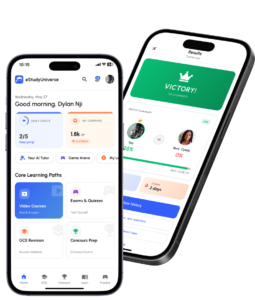
Passing GCE A Level in Cameroon requires more than reading notes once. You need a month-by-month plan that rotates subjects, schedules timed past papers, and tracks weak topics before June. eStudyUniverse is a Cameroon-focused GCE and concours preparation platform offering free past papers, study guides, and a mobile app with AI tutoring.
Free GCE past papers + the answer review in eStudyUniverse


What This Guide Covers
- An eight-month calendar you can start any Upper Sixth year
- Subject rotation strategy for science and arts combinations
- Past paper frequency targets per month
- App features that automate weak-topic detection
Months 1 to 2: Foundation Audit
Print the syllabus for each subject. Mark topics you cannot explain without notes. Download five years of papers from the GCE hub. Attempt one Paper 1 per subject at open-book pace to establish baseline scores.
Months 3 to 5: Depth Blocks
Focus two subjects per month. Biology and Chemistry in month three, Physics and Mathematics in month four, arts or electives in month five. Each week: three topic days, one timed paper, one marking and error-log day.
Use the Practice Center in the app for topic drills when full papers feel too heavy mid-week.
Months 6 to 8: Examination Simulation
Every Saturday sit a full paper for your weakest subject under strict timing. Sunday: mark with official schemes only. Monday: AI Tutor for every lost mark you cannot explain.
Sample Weekly Schedule for Upper Sixth
Monday: Mathematics timed drills plus error review. Tuesday: Biology full Paper 1. Wednesday: Chemistry structured questions. Thursday: Physics calculations. Friday: English or elective reading. Saturday: weakest subject full mock. Sunday: rest or light flashcard review.
Adjust the rotation if the answer review flags a subject dropping for two consecutive weeks.
Subject Combination Strategies
Science students with Biology, Chemistry, Physics, and Mathematics should pair Mathematics with Physics on shared mechanics days. Arts students should protect English and French writing practice even during science-heavy mock months.
Exam Month Rules
Stop learning new topics in the final ten days. Sleep eight hours. Pack examination materials the night before. Trust your error log — those topics already cost you marks once.
January to March: Foundation Phase Detail
January: print syllabi, colour-code weak topics, download ten years of papers per subject. February: first closed-book Paper 1 for each science subject — expect low scores; the baseline matters. March: begin two-subject depth blocks with teacher or AI Tutor support on red topics.
April to June: Depth Phase Detail
April: add Paper 2 structured sections under timing. May: first full three-paper mock day simulation. June: reduce new content; focus on error logs and sleep hygiene.
Balancing GCE and Concours in Upper Sixth
Some students prepare concours while still in Upper Sixth. Allocate 70% of study time to GCE until June, then shift to concours annales in July. Never neglect GCE finals for premature concours focus — weak GCE grades block concours registration entirely.
Science students should cross-link revision across Biology A Level, Physics A Level, Chemistry A Level, and Mathematics A Level hubs on eStudyUniverse.
Why Cameroon Students Need Structured Plans
Cameroonian students face unique constraints: mobile data costs, power cuts, large class sizes, and competitive concours after GCE. Unstructured revision — reading notes without timed papers — fails under these conditions because examination performance requires speed and accuracy under pressure.
Structured plans rotate subjects, schedule timed papers, and force error review within 24 hours. eStudyUniverse automates weak-topic detection so you adjust rotation based on data rather than guesswork.
Recovering When You Fall Behind the Plan
Almost every student falls behind a month-by-month plan at some point. Illness, a family obligation, a school strike, or a term that simply moved faster than expected will put you weeks off schedule. What separates candidates who still do well is not avoiding this but handling it without panic.
Do not restart the plan. The instinct after losing six weeks is to go back to the beginning and rush through everything at double speed. This produces a shallow second pass over material you already half know, and it costs you the depth phase entirely. Accept the loss and re-enter the plan at the point the calendar has reached, not the point you stopped.
Audit before you accelerate. Spend one session, not one week, working out what you actually missed. Take a past paper covering the skipped topics and mark it honestly. Some of what you missed in class you will have absorbed anyway from textbooks or from related topics. The genuine gaps are usually narrower than the number of lost weeks suggests.
Rank the gaps by examination weight. Not every missed topic costs the same. A topic that appears in most papers, carries substantial marks, and underpins later material is worth three sessions. A topic that appears occasionally as a short question is worth one, and it is legitimate to accept that you will lose those marks if the alternative is losing a major topic. Past papers tell you which is which faster than any syllabus document.
Protect the simulation phase above all. If something has to be cut, cut content coverage rather than timed practice. A student who has covered ninety percent of the syllabus and sat eight full timed papers will outscore one who covered everything and sat two. Timed practice is where marks are actually converted, and it is always the first thing sacrificed when students feel behind.
Rebuild the schedule around the weeks you have left. Recount the real available hours after school, chores, and travel, then rewrite the remaining months against that number rather than the original one. A plan built on hours you do not have will fail again in the same place.
Falling behind once is normal. Falling behind, restarting, and falling behind again is the pattern that costs grades, and an honest re-plan is what breaks it.
Setting Subject Priorities From the 2026 Data
A month by month plan works better when the time each subject receives reflects how hard that subject actually is. The 2026 Advanced Level results, released on 21 August 2026, give a clear ranking to work from.
Pass rates by subject in the 2026 session ran as follows. Pure Mathematics with Statistics returned 21.14 percent. Information and Communication Technology returned 34.04 percent. Economics returned 40.13 percent. Literature in English returned 41.23 percent. History returned 43.95 percent. Pure Mathematics with Mechanics returned 44.34 percent. Computer Science returned 44.93 percent. Chemistry returned 48.45 percent. French returned 50.33 percent. Biology returned 59.07 percent. Further Mathematics returned 59.9 percent. Physics returned 63.47 percent. Geography returned 65.51 percent. Philosophy returned 69.6 percent. English Language returned 76.31 percent. Religious Studies returned 86.57 percent.
Weight the plan, do not split it evenly. If your combination includes Pure Mathematics with Statistics or ICT, those subjects need more of your months than the schedule would give them by default. Roughly four candidates in five did not pass Pure Mathematics with Statistics in 2026.
Do not read a high pass rate as a free grade. English Language passed at 76.31 percent, but the grade distribution within that was heavily weighted toward the middle. Passing is common; a strong grade is not. If a faculty requires a specific grade rather than a pass, plan accordingly.
What a Seventeen Point Drop Should Change in Your Plan
The overall Advanced Level pass rate fell from 79.39 percent in 2025 to 61.78 percent in 2026. If you are preparing for the next sitting, that is information, not just news.
Assume the harder pattern continues until proven otherwise. Planning for the 2025 difficulty level and meeting the 2026 one is how a large number of candidates were caught out. Build the plan against the harder assumption. If the next session is kinder, you lose nothing.
Increase the volume of timed practice specifically. Sessions that get harder usually get harder through unfamiliar question framing rather than new content. The defence against unfamiliar framing is having seen many papers under time pressure, not having read the syllabus more times.
Start earlier than the plan says if you are carrying a low pass rate subject. A subject passing at around twenty percent nationally cannot be rescued in the final term. It needs to be in the plan from the first month.
Review the Plan Every Four Weeks
A month by month plan written in September and never revisited is a document, not a plan. Put a fixed review date at the end of each month: sit one timed paper, compare the score with the previous month, and adjust the coming month accordingly.
The review is what converts a schedule into a feedback loop. Subjects improving on their own can give up a session. Subjects flat across two consecutive reviews need a change of method rather than more hours, because repeating an approach that has already failed twice is the most reliable way to arrive at the examination with the same weakness you started with.
Frequently Asked Questions
Author: Keng Elson, mathematics educator and co-founder of eStudyUniverse and MAFA.
Related articles: Free GCE past questions hub | Biology A Level hub | Physics A Level hub | eStudyUniverse app | How to use past papers
Start Your Next Chapter in the App
Used by 10,000-plus students in Cameroon. Download GCE and concours past papers, practise offline, and see your weak topics in the answer review before your next sitting.
Free download · Offline mode · AI Tutor · Practice Center