
 By Cyril Kimbi
An AI tutor will answer any question you put to it. That is exactly the problem. Used carelessly it becomes a very efficient way to watch someone else solve your paper, and candidates who revise that way are surprised on exam day. Used deliberately it does something a textbook cannot: it answers the specific question you are stuck on, at the moment you are stuck, at two in the morning.
The rule that decides everything
Attempt first. Always.
A question you have not tried teaches you nothing when it is explained, because you do not yet know which part you could not do. You will read the solution, recognise every step, and conclude you understood it. Recognition is not recall, and the exam tests recall.
Attempt it, get stuck, and the situation inverts. Now you know precisely where the wall is, and an explanation lands on a question you actually have. That is the difference between reading an answer and learning something.
The practical test: before you ask anything, you should be able to finish the sentence “I got as far as ___ and then I could not ___”. If you cannot, you have not attempted it yet.
Four ways to ask that actually work
| Instead of | Ask | Why it is better |
|---|---|---|
| “Solve this question” | “Here is my working. Where is the first mistake?” | Finds your error, not a generic method |
| “Explain photosynthesis” | “I understand the light reaction but not why NADPH matters. Explain that link.” | Targets the actual gap |
| “Is this right?” | “Mark this against what an examiner would award, and say what is missing.” | Shifts from reassurance to assessment |
| “Give me notes on X” | “Ask me five questions on X and tell me which ones I answered weakly.” | Makes you retrieve instead of read |
That last row is the highest-value use and the least obvious. Being questioned is harder than reading, and harder is the point — retrieving an answer from memory is what makes it stick, which passively re-reading notes does not.
Where an AI tutor genuinely beats the alternatives
- It is available when you are stuck. Most revision happens at night and at weekends, when a teacher is not reachable. A question parked until Monday is usually a question abandoned.
- It will repeat itself without irritation. Many students will not ask a teacher to explain the same thing a fourth time. That reluctance is a real cause of persistent gaps.
- It can re-explain in another way. “Explain that again without using the formula” is a reasonable request to make of software and an awkward one to make of a person.
- It works on your specific script. General explanations are everywhere. An explanation of the mistake in line three of your own working is not.
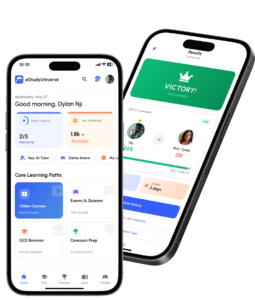
In the eStudyUniverse app the tutor runs in context — you can ask about the question you are currently working on rather than retyping it, and you can attach a photograph of your written working. Conversations are kept, so you can return to an explanation a week later instead of re-deriving it. Messages written while you are offline are queued and sent when a connection returns, which matters when data is intermittent.
Where it should not be trusted
Being straightforward about this is more useful than pretending otherwise.
Anything a board decides. Dates, fees, syllabus changes, eligibility, results. These come from the examination board and the ministry, and no AI should be your source for them — verify at the source, every time.
Confident errors. An AI tutor can be wrong in a fluent, plausible way. In subjects with definite answers, check the result: work it back, or compare with the marking scheme. Our guide on using past papers and marking schemes covers how to mark properly.
Your actual exam technique. No conversation reproduces sitting a timed paper under pressure. The tutor repairs understanding; only timed practice repairs performance.
A sequence that works
- Work a past paper section under time, with nothing open.
- Mark it strictly against the scheme.
- For every mark lost, write which it was: I did not know this, I ran out of time, or I answered a different question from the one asked.
- Take only the first category to the tutor, with your working attached.
- Ask it to question you on the same topic a few days later.
Steps 2 and 3 are the ones candidates skip, and they are where the value is. The tutor is step 4 — it repairs what the diagnosis found. Running it as step 1 inverts the whole thing.
Frequently Asked Questions
Will using an AI tutor make me lazy?
It will if you ask before attempting. Attempt first and it becomes a diagnostic tool instead.
Can it mark my work like an examiner?
It can tell you what is missing against the expected points. Confirm against the official marking scheme for anything that matters.
Does it work without internet?
Messages written offline are queued and sent when you reconnect, so a dropped connection does not lose your question.
Can I show it my handwriting?
Yes — you can attach a photograph of your working, which is the point at which it can find your specific mistake.
Should I trust it on exam dates?
No. Dates, fees and eligibility come from the board. Verify them at the source.