

 By Cyril Kimbi and Keng Elson
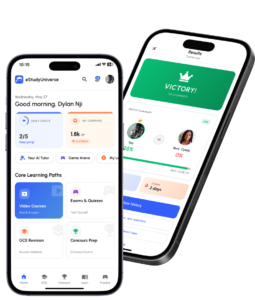
Downloading past papers is easy. Using them effectively is what separates students who improve from students who stall. This step-by-step method works for GCE O and A Level in Cameroon. eStudyUniverse is a Cameroon-focused GCE and concours preparation platform offering free past papers, study guides, and a mobile app with AI tutoring.
Resitting? Free GCE past papers + AI Tutor in eStudyUniverse


Why Past Papers Beat Notes Alone
Papers train timing, command words, and examiner expectations. Notes train recall but not examination performance under pressure.
The Five-Step Method
- Download five years from the GCE hub.
- Sit papers timed with no phone.
- Mark strictly with official schemes.
- Fix errors within 24 hours using AI Tutor or teacher help.
- Graph weekly scores in the answer review.
Marking Like an Examiner
Award method marks even when the final answer is wrong. Deduct for missing units in Physics and Chemistry. In Mathematics, check whether working is shown clearly enough for partial credit. Use official mark schemes only — answer keys from random blogs often contain errors.
Spacing and Interleaving
Do not sit the same subject paper three days in a row. Space attempts by at least 72 hours so you rely on understanding rather than short-term memory. Interleave subjects: Mathematics Monday, Biology Wednesday, Chemistry Friday.
When to Stop Repeating One Paper
After one timed attempt and one error review, move to a different year. Repeating the same paper weekly inflates scores without building adaptability to new question wording.
Tracking Progress Over Time
Record percentage scores in a spreadsheet or the answer review. Flat scores for three weeks mean you need a method change — more timed practice, not more passive reading.
Paper 1 vs Paper 2 vs Paper 3 Strategy
Paper 1 rewards speed and breadth — practise without notes until you finish within time. Paper 2 rewards structured answers — read the full paper before starting and attempt your strongest section first. Paper 3 for sciences tests practical skills — attend every school lab session or study alternative-to-practical papers at home.
Building an Error Log Template
Columns: date, paper year, question number, topic, marks lost, root cause (concept gap, careless error, time pressure). Review the log every Sunday and schedule Monday drills on the top three recurring topics.
Group Marking Sessions
Marking your own work honestly is hard. Swap papers with two classmates and mark strictly using official schemes. Discuss disagreements — they reveal blind spots.
Science students should cross-link revision across Biology A Level, Physics A Level, Chemistry A Level, and Mathematics A Level hubs on eStudyUniverse.
Measuring Progress With Real Data
Track percentage scores after every timed paper. A flat line for three weeks signals you need harder timed practice or better error review — not more passive reading. Rising scores across four weeks signal your method works even if absolute grades still feel low.
the answer review in eStudyUniverse plots 7-day, 30-day, and 90-day weak-topic trends automatically when you log attempts in the app.
How Far Back Should You Go, and What About Syllabus Changes?
Once students start collecting past papers they usually end up with more years than they can use, and the obvious question follows: is a paper from a decade ago still worth sitting, or is it teaching outdated material?
The recent years carry the current style. The most recent papers show how the examiners are currently phrasing questions, how marks are distributed, and which command words are in favour. Sit these under full timed conditions and treat them as the closest thing to a rehearsal. Reserve two or three of the newest papers, unopened, for the final weeks so that you have genuinely unseen material for your last simulations.
Older papers are for topic drilling, not rehearsal. Papers from further back remain useful for a different purpose. When you need six questions on the same topic to drill a weakness, older papers supply them. The underlying science, mathematics, and literature analysis rarely changes as fast as the presentation does, so a question from years ago still exercises the same understanding.
Check questions against the current syllabus, not the current textbook. Before deciding an old question is obsolete, open the syllabus for your subject and find the topic. If it is listed, the question is valid practice regardless of its age. This single habit prevents both errors students make here: dismissing useful papers, and grinding through topics that were removed years ago.
Recognise genuine drift. Real changes do occur. Practical and coursework arrangements are adjusted, some topics are dropped or added, and the balance between papers is occasionally rebalanced. Signs that a question no longer reflects the syllabus include terminology your teacher does not use, a paper structure that does not match the current one, and topics your textbook does not contain at all. When you are unsure, ask a teacher rather than guessing, because a wrong assumption in either direction costs revision time.
A practical rule. Use the most recent papers for timed simulation, everything older for topic drilling, and the syllabus as the referee whenever a question looks unfamiliar. Marking schemes from older papers are still valuable for learning how marks are awarded, even where the exact question has since disappeared.
Quantity is not the goal. Ten papers worked through properly, marked honestly, and mined for error patterns will move your grade further than forty papers skimmed for reassurance.
Practising When You Have No Marking Scheme
Many students collect papers easily but cannot find the corresponding marking schemes, and then stop practising because they cannot check their work. Unmarked practice is still worth far more than no practice, provided you close the loop some other way.
Mark against the textbook first. For factual and calculation questions, your textbook and class notes settle most answers. Work through your script with the book open and be strict: an answer that is roughly right is wrong at examination level.
Use a study group as the scheme. Three students who sat the same paper independently and then compare scripts will resolve most disagreements between them, and the arguments about which answer is right are where the actual learning happens.
Take structured questions to a teacher in batches. Teachers rarely have time to mark a full script on request, but most will look at four or five specific questions you have already attempted. Bring your attempt, not a blank question.
Ask the AI Tutor for the method, not the answer. Work the question yourself first, then check the reasoning step by step in the eStudyUniverse app. A worked method you can follow is more useful than a final answer you cannot reproduce under pressure.
Choosing Which Papers to Prioritise Using Real Difficulty Data
Past paper practice pays off fastest when you spend the most time on the papers that defeat the most candidates. The 2026 Advanced Level results, released on 21 August 2026, show exactly where that is.
Of 26,297 candidates who sat Pure Mathematics with Statistics, 5,559 passed, a rate of 21.14 percent. Information and Communication Technology returned 34.04 percent from 29,252 candidates. Economics, the largest entry in the session at 32,036 candidates, returned 40.13 percent. Chemistry returned 48.45 percent from 31,179.
At the other end, Religious Studies returned 86.57 percent, Food Science and Nutrition 87.99 percent, English Language 76.31 percent, and Philosophy 69.6 percent.
What to do with this. If your combination contains a subject from the top of the difficulty list, that subject deserves a disproportionate share of your past paper hours, and it deserves them early. A subject where four candidates in five do not pass is not a subject to leave until the final term.
Volume matters more in the harder subjects. In a subject passing at over eighty percent, a handful of papers is usually enough to learn the format. In a subject passing at around twenty percent, the format is not the problem and volume is the only reliable answer. Work every paper you can find, then work them again after a gap.
Do not let a comfortable subject absorb your practice time. Students naturally practise the subjects where marking feels good. Track the hours you actually spend per subject for one week, and you will usually find they run inversely to where the marks are being lost.
Keep Every Marked Script
Marked scripts are the most valuable revision material you will ever produce, and most students throw them away. A paper you have sat, marked, and annotated contains your specific errors in your own handwriting, which is information no textbook can give you.
File them by subject and revisit them a month later. Sit the same paper again cold and compare. Errors that have disappeared are genuinely fixed. Errors that recur after a month are the ones that will follow you into the examination hall, and they need a different approach rather than another repetition.
Frequently Asked Questions
Author: Keng Elson, mathematics educator and co-founder of eStudyUniverse and MAFA.
Related articles: Free GCE past questions hub | Mathematics past questions | eStudyUniverse app
Start Your Next Chapter in the App
Used by 10,000-plus students in Cameroon. Download GCE and concours past papers, practise offline, and see your weak topics in the answer review before your next sitting.
Free download · Offline mode · AI Tutor · Practice Center