
 By Cyril Kimbi
Polytechnique Yaoundé concours preparation is the most demanding engineering entrance examination challenge in Cameroon. The National Advanced School of Engineering École Nationale Supérieure Polytechnique de Yaoundé (ENSP) is widely regarded as the most prestigious engineering institution in Cameroon, and among the best in Central and West Africa. Its graduates lead Cameroon’s most complex engineering projects, hold senior positions in the energy sector, and occupy technical leadership roles across the country’s infrastructure development programmes.
Getting into Polytechnique Yaoundé requires exceptional preparation. The entrance examination is competitive at a level that separates it from other engineering concours in Cameroon the Mathematics and Physics questions go deeper, the marking is stricter, and the candidates who succeed typically have prepared for 6 months or more with disciplined daily practice.
This guide gives you the complete roadmap for Polytechnique Yaoundé concours preparation: the admission requirements, exactly what the examination tests, a subject-by-subject strategy, a 6-month preparation plan, and the precise mistakes that eliminate even capable candidates.
What Is Polytechnique Yaoundé (ENSP)?
The École Nationale Supérieure Polytechnique de Yaoundé (ENSP) is one of the grandes écoles of Cameroon under the University of Yaoundé I. It offers 5-year engineering programmes (Ingénieur Polytechnicien) and shorter technical programmes across multiple engineering disciplines:
- Civil Engineering structural design, geotechnics, transportation, hydraulics
- Electrical Engineering power systems, control engineering, high voltage, telecommunications
- Mechanical Engineering thermodynamics, fluid mechanics, machine design, aeronautics
- Computer Science and Engineering software systems, networks, AI, embedded systems
- Industrial Engineering production management, logistics, quality, maintenance
- Telecommunications Engineering communication systems, signal processing, networks
- Chemical and Biochemical Engineering process engineering, materials, environmental engineering
- Petroleum and Gas Engineering upstream and downstream operations, reservoir engineering
ENSP graduates hold internationally recognised engineering degrees and are in demand across Cameroon’s oil and gas sector, the energy sector (AES SONEL, ENEO), construction, and technology companies. Admission is exclusively by competitive entrance examination there is no quota for direct entry.
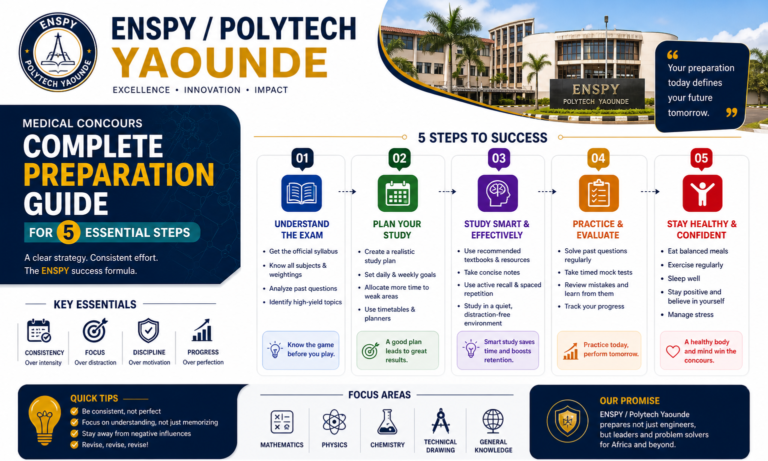
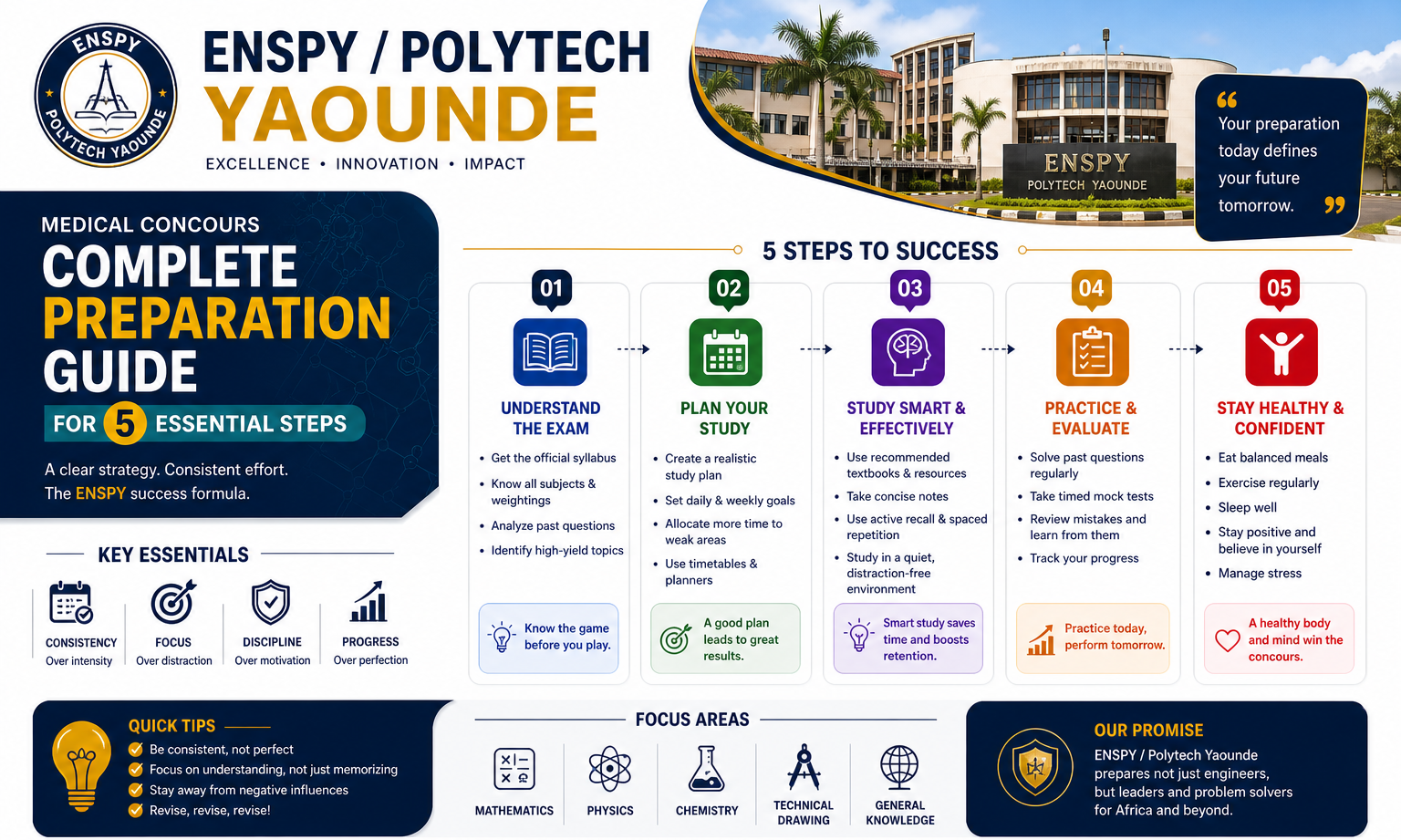
Polytechnique Yaounde Concours ENSPY
Polytechnique Yaoundé Admission Requirements
Polytechnique Yaoundé concours preparation must begin with confirming that you meet the entry requirements:
Academic qualifications:
- GCE A Level with passes in Mathematics, Physics, and ideally Chemistry
- Strong grades in Mathematics and Physics are essential borderline passes are rarely competitive
- Students with Further Mathematics at A Level are at a significant advantage in the Mathematics component
- French Baccalauréat (Séries C or D) candidates are also eligible this is a bilingual examination
Age limit:
- The age limit is published annually in the official call for applications. Typically, candidates must not exceed 22 to 25 years at the time of the examination. Confirm the current limit each year.
Application:
- Applications are submitted to the ENSP Admissions Office or through the University of Yaoundé I application portal
- The application window is published in the official call for applications deadlines are strictly observed
- Required documents: certified GCE A Level results or Baccalauréat, birth certificate, identity photos, nationality certificate, and completed application form
Language of examination:
- ENSP Polytechnique entrance examinations are bilingual Mathematics and Physics papers are available in both French and English. Candidates sit in their preferred language.
For current requirements and the official call for applications, visit the ENSP Polytechnique Yaoundé official website.
What the Polytechnique Yaoundé Examination Tests
Polytechnique Yaoundé concours preparation must be calibrated to the actual difficulty and depth of the examination. This is not a GCE A Level test it is an entrance examination that selects Cameroon’s strongest engineering candidates from an already-qualified pool.
Mathematics This is the heaviest and most differentiated component. The Mathematics examination at Polytechnique Yaoundé goes substantially beyond GCE A Level content:
- Advanced calculus: differential equations (first and second order), series convergence (Fourier series at the introductory level), multiple integrals (double and triple integrals at the basic level)
- Linear algebra: matrices (eigenvalues, eigenvectors, diagonalisation), linear transformations, vector spaces
- Complex numbers: modulus-argument form, De Moivre’s theorem, roots of complex numbers, Argand diagrams and loci
- Combinatorics and probability: permutations, combinations, probability distributions, mathematical expectation
- Analytical geometry: conics (parabola, ellipse, hyperbola), parametric equations, polar coordinates
- Proof by induction and formal mathematical reasoning
Candidates who have studied GCE A Level Further Mathematics are substantially better prepared for the Polytechnique Mathematics component than those who studied only regular A Level Mathematics. If you have not taken Further Mathematics, you will need to self-study its content as part of your Polytechnique preparation.
Physics The Physics examination at Polytechnique Yaoundé extends beyond standard GCE A Level content into introductory university-level Physics:
- Classical mechanics: Newtonian dynamics, rotational mechanics (moment of inertia, angular momentum, torque), Lagrangian mechanics (introductory level)
- Electricity: advanced circuit analysis (Kirchhoff’s laws in complex networks), AC circuit theory (impedance, resonance, phasors), electromagnetic field theory (introductory)
- Waves and optics: interference, diffraction, polarisation, the wave equation, Fourier analysis of waves (conceptual)
- Thermodynamics: thermodynamic laws and processes, Carnot cycle, entropy (introductory), statistical mechanics (conceptual)
- Modern Physics: wave-particle duality, Schrödinger equation (conceptual), atomic spectra, nuclear physics
Chemistry Tested at GCE A Level standard, focusing on:
- Organic chemistry (mechanisms, synthesis routes, functional group reactions)
- Thermochemistry and kinetics
- Electrochemistry
- Acid-base and equilibrium chemistry
- Chemical applications relevant to engineering (corrosion, materials, polymers)
General Culture and French/English Expression Tests critical reasoning, current affairs (Cameroon and international), and language expression ability. This section is bilingual French or English based on candidate preference.
Your 6-Month Polytechnique Yaoundé Preparation Strategy
Polytechnique Yaoundé concours preparation requires 6 months of structured, intensive daily study. This is not the preparation you do alongside regular GCE revision it requires dedicated time beyond your standard school programme.
Month 1 GCE A Level Mastery Baseline
Before extending to university-level content, your GCE A Level Mathematics, Physics, and Chemistry must be completely solid. Spend month 1 doing a rapid, thorough review of all GCE A Level content in these three subjects. Use GCE Mathematics, Physics, and Chemistry past questions from eStudyUniverse to benchmark your current level. Identify specific weak areas and address them aggressively.
Month 2 Further Mathematics and Advanced Mathematics
Spend month 2 entirely on the Mathematics topics that go beyond GCE A Level: complex numbers (De Moivre, roots, loci), matrices (eigenvalues, eigenvectors), linear algebra (vector spaces, linear transformations), and introductory differential equations. These topics appear in virtually every Polytechnique Mathematics paper and cannot be approached for the first time in the examination.
GCE Further Mathematics past questions are essential reading for this month the Further Mathematics syllabus covers complex numbers and advanced calculus that directly correspond to Polytechnique examination content.
Month 3 Advanced Physics and Chemistry Consolidation
Extend Physics preparation to university-level content: rotational mechanics (moment of inertia, angular momentum), advanced circuit analysis (impedance, phasors, AC resonance), thermodynamics (Carnot cycle, entropy), and wave physics beyond the GCE syllabus. Simultaneously consolidate Chemistry especially organic mechanisms and electrochemistry to examination standard.
Month 4 Past Paper Immersion
Begin working through Polytechnique Yaoundé past questions systematically. Two past paper sessions per week minimum one Mathematics-focused, one Physics and Chemistry-focused all under strict timed examination conditions. Mark every paper, identify every wrong answer, understand every error, re-attempt wrong question types.
This is the month where most improvement happens provided months 1 to 3 have built the necessary content foundation. Without the content, past paper practice reveals gaps but cannot fill them in time.
Month 5 Integration and Examination Technique
Practise papers that mix all subjects as the actual examination does. Focus on time management across the full paper. Practise allocating time per question: high-mark questions deserve more time; multiple choice questions should not exceed 2 minutes each. This month also concentrate on General Culture read Cameroon and African current affairs, economic development, science and technology news daily.
Month 6 Consolidation and Final Preparation
No new content. Three full simulations per week in weeks 1 to 3. Final 2 weeks: one simulation per week only. Review your error log from months 4 and 5 these are your most important revision materials. Prioritise rest in the final week. Candidates who arrive at the examination rested and confident consistently outperform candidates who stay up studying the night before.
The eStudyUniverse app gives you offline access to all GCE Mathematics, Physics, Chemistry, and Further Mathematics past questions your preparation foundation for all six months. The app tracks your performance by topic and provides AI-powered explanations for every solution. Download it free on the.
The 6 Mistakes That Eliminate Polytechnique Candidates
Mistake 1: Treating Polytechnique preparation as GCE revision. The examination extends substantially beyond GCE A Level. Candidates who prepare only to GCE standard encounter unfamiliar content in the examination and lose marks on questions that prepared candidates find manageable.
Mistake 2: Not studying Further Mathematics content. Complex numbers, eigenvalues, and advanced calculus all Further Mathematics topics appear regularly in the Polytechnique Mathematics examination. Candidates without this content are at a systematic disadvantage.
Mistake 3: Weak time management. The Polytechnique examination is long and the questions are demanding. Students who have never practised under strict time pressure consistently run short in the real examination. Time management skill is built through repeated timed practice not by reading about it.
Mistake 4: Preparing Mathematics alone. Some candidates invest almost all preparation time in Mathematics at the expense of Physics and Chemistry. Since all subjects contribute to the ranking score, a candidate who is exceptional in Mathematics but mediocre in Physics and Chemistry finishes below a candidate who is strong across all three.
Mistake 5: Not building genuine understanding. Polytechnique Mathematics questions present problems in formats you have never seen before. Only candidates with genuine mathematical understanding not just memorised techniques can solve novel problems under pressure.
Mistake 6: Starting too late. Six months is the minimum for a competitive Polytechnique Yaoundé preparation. Candidates who begin 8 weeks before the examination regardless of their GCE results cannot cover the content gap in time.
Frequently Asked Questions Polytechnique Yaoundé Concours
What is the Polytechnique Yaoundé entrance examination like?
The Polytechnique Yaoundé entrance examination is a competitive written test in Mathematics, Physics, Chemistry, and General Culture. It is bilingual (French and English). The Mathematics and Physics components are significantly more advanced than GCE A Level, extending into university-level content. Admission is purely rank-based the highest-scoring candidates fill the available places.
What GCE A Level subjects do I need for Polytechnique Yaoundé?
You need GCE A Level passes in Mathematics, Physics, and Chemistry at minimum. Candidates with GCE A Level Further Mathematics are significantly better prepared for the Mathematics component. Strong grades not just passes are essential, as you will be competing against candidates with the same qualifications but higher scores.
How competitive is admission to Polytechnique Yaoundé?
Polytechnique Yaoundé admission is the most competitive engineering concours in Cameroon. A large number of highly qualified candidates compete for a limited number of places. Successful candidates typically have near-perfect scores in Mathematics and Physics and strong scores across all components. Preparation that begins 6 months before the examination is the baseline not exceptional.
Where can I get past questions for Polytechnique Yaoundé preparation?
GCE A Level past questions for Mathematics, Physics, and Chemistry the foundation of Polytechnique preparation are available free on eStudyUniverse. GCE Further Mathematics past questions, which cover the complex numbers and advanced calculus tested at Polytechnique, are also available. The eStudyUniverse app provides offline access to all these resources.
Is Polytechnique Yaoundé in French or English?
The Polytechnique Yaoundé entrance examination is bilingual. Mathematics and Physics papers are available in French and English, and candidates choose their preferred language. The institution itself operates bilingually. Candidates from both the Anglophone and Francophone systems are eligible to apply.
How does Polytechnique Yaoundé compare to FET Buea and NAHPI Bamenda?
Polytechnique Yaoundé is generally considered the most prestigious and most competitive of the three. The entrance examination goes deepest into university-level content. FET Buea and NAHPI Bamenda are excellent institutions with rigorous examinations but at a level closer to GCE A Level standard. Students who pass the Polytechnique examination typically have the preparation depth to pass FET and NAHPI as well.
Free Past Questions for Polytechnique Yaoundé Preparation
Polytechnique Yaoundé concours preparation must be built on a solid foundation of the underlying GCE A Level content and that foundation is available free on eStudyUniverse.
Download free GCE Mathematics, Physics, Chemistry, and Further Mathematics past questions from 2010 to present at eStudyUniverse. These are the foundation papers that prepare you for the advanced content in the Polytechnique examination. No account required.
For official application information and the annual call for applications, visit the ENSP Polytechnique Yaoundé official website and the Cameroon GCE Board website.
Practice and track your preparation with the eStudyUniverse app free on the. AI-powered explanations, topic-by-topic question banks, and answer review all in one place, available offline.
Related resources: GCE Further Maths past questions | GCE Physics past questions | GCE Chemistry past questions | GCE Mathematics past questions
ENSP Yaounde Past Papers in the App
Sit timed Polytechnique Yaounde papers offline, mark with solutions, and drill calculation speed in the Practice Center.


Free download · Offline mode · AI Tutor · Practice Center
Related articles: Polytechnique past questions | ENSP concours guide | Concours hub
Free ENSP past papers + AI Tutor for engineering prep
Explore free GCE past questions PDF on eStudyUniverse.