
 By Cyril Kimbi
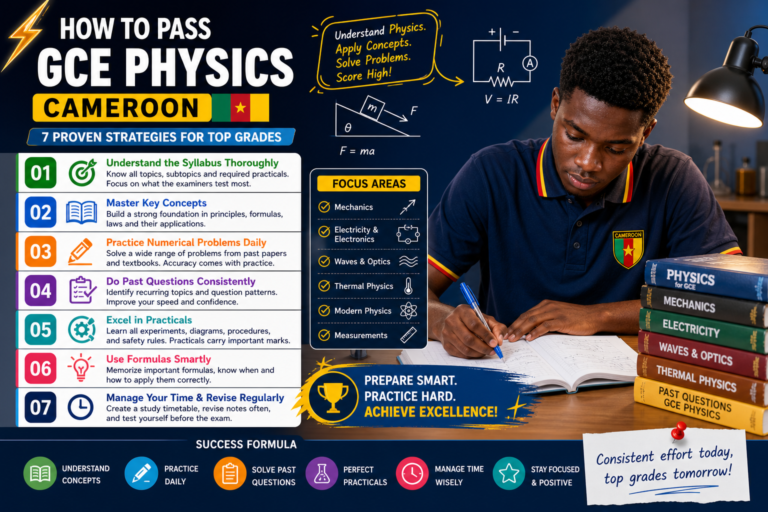
How to pass GCE Physics in Cameroon is one of the most searched questions by Cameroonian A Level and O Level students and with good reason. Physics is one of the most rewarding subjects to do well in, opening doors to engineering, medicine, technology, and the most competitive concours in the country. But it is also the subject with the lowest average pass rate, because most students approach it the wrong way.
They memorise formulas without understanding what they represent. They read examples in textbooks without solving problems themselves. They attempt past questions in the final week before the examination when there is no time left to correct the patterns that are costing them marks.
This guide gives you eight proven techniques for passing GCE Physics in Cameroon, built on analysis of GCE Physics past questions from 2010 to present and the teaching experience of the eStudyUniverse academic team.
Understanding the GCE Physics Examination in Cameroon
To know how to pass GCE Physics in Cameroon, you must first understand what the Cameroon GCE Board actually tests and how it distributes marks across the three papers.
Paper 1 Multiple Choice (1 hour 15 minutes): 40 questions covering all topics. No choice every question must be attempted. Tests recall, formula application, and logical reasoning.
Paper 2 Structured and Free-Response Questions (2 hours 30 minutes): Short structured questions and longer calculation-based and essay-type questions. This is where Physics is won or lost. Students who cannot show clear working and derive answers methodically lose large numbers of marks here.
Paper 3 Practical Paper (1 hour 30 minutes): Lab skills, data collection, graph plotting, error analysis, and experimental design. This paper is consistently under-prepared for and consistently costs avoidable marks.
O Level Physics follows a two-theory-paper plus practical structure. O Level tests foundational concepts but demands the same precision in units, significant figures, and formula use as A Level.
How to pass gce physics

Technique 1: Understand Formulas Do Not Just Memorise Them
The single most important technique in how to pass GCE Physics in Cameroon is understanding what every formula means physically, not just what it says mathematically.
Students who memorise F = ma without understanding that it describes the relationship between an applied net force, an object’s mass, and the acceleration that results cannot apply it to unfamiliar situations. GCE Physics past questions from 2010 to present consistently present familiar formulas in unfamiliar contexts a question about a car decelerating, a rocket accelerating, or a ball rolling down a slope. Students who only memorised the formula fail. Students who understand what it describes solve any version.
For every formula in the GCE Physics syllabus, answer these three questions:
- What physical situation does this formula describe?
- What are the units of every quantity in the formula?
- What happens to one quantity if another doubles or halves?
This three-question test reveals genuine understanding. If you cannot answer all three for a formula, you have not yet learned it in a way that GCE Physics examiners will reward.
Technique 2: Know the GCE Physics Topics That Appear Every Year
After analysing GCE Physics past questions from 2010 to present, these topics appear in every examination without exception:
- Mechanics Newton’s laws, momentum, projectile motion, circular motion, simple harmonic motion, energy conservation
- Electricity and Magnetism Ohm’s law, circuit calculations (series and parallel), electromagnetic induction, force on a current-carrying conductor, capacitors
- Waves and Optics wave properties, interference and diffraction, refraction, lenses, the electromagnetic spectrum
- Thermal Physics specific heat capacity, specific latent heat, ideal gas laws, thermodynamic processes
- Modern Physics photoelectric effect, nuclear reactions, radioactive decay, half-life calculations, binding energy
- Practical Skills graph drawing, error analysis, significant figures, experimental design
Mechanics and Electricity together account for approximately 40% of all marks across past papers. Master these two areas before spending time on anything else. Modern Physics questions in Paper 2 are consistently among the most straightforward structured questions available students who skip this topic are leaving predictable marks behind.
Technique 3: Show All Working in Every Calculation
How you lay out your working in Paper 2 determines how many marks you receive on calculation questions regardless of whether your final answer is correct.
GCE Physics examiners award marks at each step of a calculation:
- Identifying and writing the correct formula (1 mark)
- Substituting the correct values with correct units (1 mark)
- Carrying out the calculation correctly (1 mark)
- Stating the final answer with correct units and significant figures (1 mark)
A student who writes the correct formula, substitutes values correctly, but makes an arithmetic error at step 3 scores 3 out of 4 marks. A student who only writes the final answer even if it is correct scores 1 out of 4 marks in most marking schemes.
The layout that works for every calculation in GCE Physics past questions:
State formula: F = ma
Substitute: F = 2.5 × 3.0
Calculate: F = 7.5 N
That structure takes 10 seconds to write. It secures marks even when arithmetic goes wrong. Never skip it.
Technique 4: Master Derivations They Appear Every Year
Derivation questions are a specific feature of GCE Physics Paper 2 that many students leave blank because they have never practised them. This is a serious strategic mistake.
Derivations in GCE Physics past questions from 2010 to present typically ask students to derive one formula from others for example, deriving the expression for kinetic energy from Newton’s second law and kinematics, or deriving the formula for the period of a simple pendulum from the equation of simple harmonic motion.
Examiners award marks for each logical step, labelled with the law or principle being applied. A complete derivation done slowly and clearly scores full marks. An attempt that starts but does not finish still scores partial marks.
The most frequently tested derivations in GCE Physics include:
- Deriving F = ma from Newton’s second law definition
- Deriving the equations of motion from velocity-time graphs
- Deriving the expression for the period of a simple pendulum
- Deriving Ohm’s law from basic electrical definitions
- Deriving the wave equation v = fλ
Practise each of these from memory, on paper, until you can write them in full within 4 minutes. Then move to the less common derivations.
Technique 5: Tackle Paper 2 Data Response Questions Methodically
Data response questions appear in every GCE Physics Paper 2. They present a graph, table, or experimental result and ask students to read values, calculate gradients, identify errors, and apply theory to explain what the data shows.
Students who do poorly on these questions almost always make the same mistakes:
- Reading values off the graph axis inaccurately
- Calculating gradient using only two specific points rather than the full best-fit line
- Forgetting to include units on every extracted value
- Writing qualitative descriptions where quantitative answers with values are required
The correct approach to every data response question in GCE Physics past questions:
- Read all scales carefully before extracting any value
- State the value with its unit every time
- When asked for a trend, give three pieces of information: the direction (increases/decreases), the relationship (linearly/exponentially), and a specific numerical example from the data
- When asked to calculate gradient, choose two points as far apart as possible on the best-fit line never use plotted data points
Technique 6: Build Your Physics Study Schedule Around Active Problem Solving
The most common reason students fail to improve in GCE Physics despite hours of study is passive revision reading notes, re-reading textbook examples, watching videos without pausing to solve problems.
Physics knowledge only consolidates when you actively apply it to problems you have never seen before. Here is a 12-week study plan built around active problem solving.
Weeks 1 to 3: Study Mechanics completely. Read your notes on each topic (30 minutes), then immediately attempt 10 questions from GCE Physics past questions on that specific topic (45 minutes). Mark and review before moving to the next topic.
Weeks 4 to 6: Study Electricity, Waves, and Thermal Physics using the same pattern. One topic per study session.
Weeks 7 to 8: Study Modern Physics and complete a first full Paper 1 under timed conditions. Identify the topic areas where you are still losing marks.
Weeks 9 to 10: Full past paper sessions one complete Paper 2 per week under strict exam conditions. Mark using the scheme. Review every lost mark.
Weeks 11 to 12: Practical preparation (Paper 3 technique) plus Paper 1 timed practice alternating daily. No new topics only revision and error correction.
The eStudyUniverse app lets you practise GCE Physics questions by topic during the early weeks of this plan, then switch to full timed papers as the examination approaches. The performance analytics feature shows your scores trend by topic, so you always know where to focus. Download it free on the Google Play Store.
Technique 7: Prepare Specifically for Paper 3 Most Students Do Not
GCE Physics Paper 3 is worth a significant proportion of the final mark and is consistently the most under-prepared paper in any examination cohort. This creates an opportunity: students who prepare specifically for Paper 3 move ahead of the majority with relatively modest effort.
Paper 3 tests five skills:
- Measurement and recording reading instruments (rulers, vernier calipers, ammeters, voltmeters) accurately to the correct number of significant figures
- Table construction correct column headings (quantity / unit), consistent significant figures throughout, no missing entries
- Graph plotting appropriate scale, labelled axes with units, correctly plotted points, smooth best-fit curve or straight best-fit line
- Gradient and intercept calculation using the full range of the best-fit line, showing the triangle used to calculate gradient
- Error and uncertainty analysis understanding absolute and percentage error, identifying sources of error, suggesting valid improvements
Practise each of these five skills individually using Paper 3 questions from GCE Physics past questions on eStudyUniverse. Four dedicated practical sessions in weeks 11 and 12 of your study plan is enough to secure the marks that most students lose here by default.
Technique 8: Avoid the Physics Mistakes That Cost Students Grades
Understanding how to pass GCE Physics in Cameroon includes understanding exactly what fails students. These are the mistakes most responsible for lost marks in GCE Physics examinations:
Mistake 1: Wrong or missing units. In Physics, an answer without a unit is an incomplete answer. “The force is 7.5” scores zero. “The force is 7.5 N” scores the mark. Check units on every single answer.
Mistake 2: Too many or too few significant figures. An answer given to 5 significant figures when the data has 2 significant figures is penalised. Match your significant figures to those given in the question.
Mistake 3: Not using the formula given in the question. GCE Physics past questions sometimes provide a formula in the stem of the question. Students who use a different (equivalent) version of the formula often introduce errors. Use the formula you are given.
Mistake 4: Attempting to explain phenomena without physics. When asked to explain why an object decelerates, “because it slows down” earns zero. “Because the resultant force acts in the opposite direction to the motion, producing a negative acceleration in accordance with Newton’s second law” earns full marks.
Mistake 5: Leaving Paper 1 questions blank. There is no negative marking in GCE Physics Paper 1. An unanswered question scores zero. A guessed answer has a 25% chance of scoring a mark. Attempt every single question.
Frequently Asked Questions GCE Physics in Cameroon
How many papers are in GCE A Level Physics Cameroon?
GCE A Level Physics in Cameroon has three papers. Paper 1 is multiple choice covering all topics (1 hour 15 minutes). Paper 2 is structured and free-response questions including calculations, data analysis, and essay-type questions (2 hours 30 minutes). Paper 3 is the practical paper covering experimental skills, graph drawing, and error analysis (1 hour 30 minutes).
What topics appear most in GCE Physics past questions in Cameroon?
Based on GCE Physics past questions from 2010 to present, the most frequently examined topics are Newton’s laws and momentum, projectile motion, simple harmonic motion, electromagnetic induction, circuit calculations, the photoelectric effect, nuclear decay and half-life, specific heat capacity, refraction and lenses, and wave interference and diffraction. Mechanics and Electricity appear in every paper without exception.
How do I improve my GCE Physics calculation technique?
Improve your calculation technique by always writing the formula, then substituting values with units, then calculating, then stating the answer with units. Never skip steps. Use GCE Physics past questions from 2010 to present to practise this layout until it becomes automatic. Review every mark you lose on calculations to identify whether the error is conceptual (wrong formula) or procedural (arithmetic or units).
Where can I download free GCE Physics past questions in Cameroon?
Free GCE Physics past questions for O Level and A Level from 2010 to present are available on eStudyUniverse. No account is required for free papers. Marking guides with worked solutions are available for premium download.
What is the GCE O Level Physics syllabus in Cameroon?
GCE O Level Physics in Cameroon covers General Physics (measurement, scalar and vector quantities), Mechanics (forces, motion, energy, pressure), Thermal Physics (temperature, heat transfer, specific heat), Properties of Waves (light and sound), Electricity and Magnetism (circuits, electromagnetism), and Atomic Physics. The syllabus is set by the Cameroon GCE Board and examined across two theory papers and a practical component.
How long should I study for GCE Physics?
A 12-week structured study programme is sufficient for most students to improve significantly in GCE Physics. The key principle is active problem solving not passive note reading. Students who complete at least 20 timed past paper questions per week during weeks 1 to 8, then full past papers in weeks 9 to 12, consistently outperform students who spend three times as many hours reading without practising.
Download Free GCE Physics Past Questions
Every technique in this guide on how to pass gce physics cameroon past questions study guide is built around one practice: solving real GCE Physics past questions from the Cameroon GCE Board under timed conditions. There is no shortcut that replaces this.
Download free GCE Physics past questions for O Level and A Level from 2010 to present at eStudyUniverse. No account required for free papers. Marking guides with full worked solutions are available for premium download.
For the official GCE Physics syllabus, visit the Cameroon GCE Board official website.
Practice offline anywhere with the eStudyUniverse app available free on the Google Play Store. The app includes AI-powered feedback on Physics answers, topic-by-topic practice, and performance tracking so you always know which areas to prioritise.
Browse all GCE past questions at the eStudyUniverse GCE past questions hub. Related subjects: GCE Further Mathematics past questions | GCE Chemistry past questions
Related: Browse free GCE past questions PDF for O Level and A Level revision on eStudyUniverse.
Free GCE Physics past papers + offline mode


Practise GCE Physics Timed Papers
Mechanics, electricity, and waves: sit full Physics papers offline, unlock solutions, and track improvement week on week before results season.
Free download · Offline mode · AI Tutor · Practice Center
Related articles: GCE Physics past questions PDF | Free GCE past questions hub | Physics A Level hub