
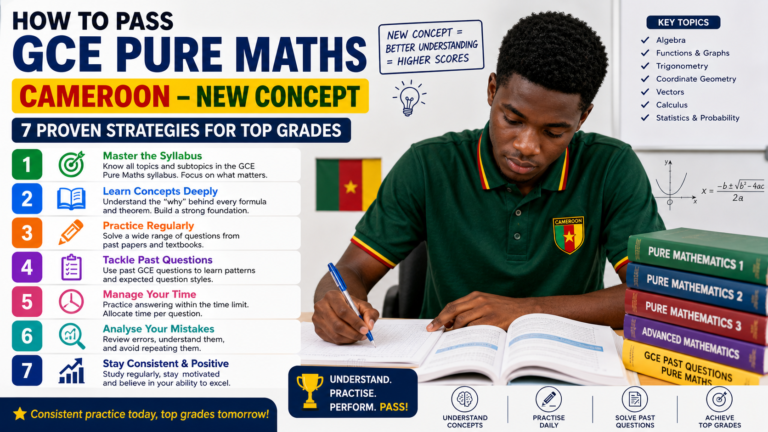
 By Keng Elson
How to pass GCE Mathematics in Cameroon is a question that matters enormously not only for the grade itself, but for what it unlocks. GCE Mathematics is a prerequisite for engineering concours, a strong advantage for medical concours preparation, and a requirement for virtually every competitive university programme in science, technology, finance, and economics in Cameroon. A strong GCE Mathematics result opens doors that nothing else replaces.
I am Keng Elson, co-founder of eStudyUniverse and the MAFA Mathematics Competition, an annual competition for secondary school and university students across Cameroon designed to develop advanced mathematical problem-solving skills. Everything in this guide comes from years of working with students at every level of the GCE Mathematics preparation journey.
The students who pass GCE Mathematics in Cameroon with distinction share one characteristic: they practise more problems than they read theory. This guide shows you exactly how.
Understanding the GCE Mathematics Examination in Cameroon
Before learning how to pass GCE Mathematics in Cameroon, you need to understand the structure of what you are preparing for.
GCE A Level Mathematics is examined across two papers covering Pure Mathematics and applied Mathematics (Statistics or Mechanics, depending on your school’s option).
Paper 1 Pure Mathematics (3 hours): This is the core paper. It covers Algebra, Calculus, Trigonometry, Coordinate Geometry, Sequences and Series, and Logarithms. It demands both procedural accuracy and the ability to derive results.
Paper 2 Applied Mathematics (3 hours): Covers Statistics (probability, distributions, hypothesis testing, regression) and/or Mechanics (kinematics, Newton’s laws, moments, energy). Check with your school which Applied option is examined.
GCE Further Mathematics is a separate, more advanced qualification examined across two papers. Further Mathematics covers Complex Numbers, Matrices, Advanced Calculus (reduction formulae, improper integrals), Proof by Induction, and Further Applied Mathematics. It is taken alongside regular A Level Mathematics by students aiming for engineering or mathematics-intensive programmes.
GCE O Level Mathematics is a two-paper examination covering Arithmetic, Algebra, Geometry, Trigonometry, Statistics, and basic Calculus. O Level Mathematics rewards clear working, correct use of formulas, and accurate arithmetic.
Method 1: Build Fluency in Pure Mathematics It Carries the Most Marks
How to pass GCE Mathematics in Cameroon at A Level begins and ends with Pure Mathematics fluency. Paper 1 is the highest-marks paper and Pure Mathematics is what it tests almost entirely.
The Pure Mathematics topics that appear in every GCE Mathematics past paper from 2010 to present:
Calculus differentiation (product rule, quotient rule, chain rule, implicit differentiation, parametric differentiation) and integration (by substitution, by parts, partial fractions, volumes of revolution). Calculus questions appear in every Paper 1. They are worth a large proportion of the total marks.
Algebra polynomial division, remainder theorem, factor theorem, binomial expansion (including fractional and negative powers), roots of polynomials, inequalities, partial fractions. These topics form the foundation for calculus questions.
Trigonometry compound angle formulas, double angle formulas, R sin(x + α) form, trigonometric equations and identities, inverse trigonometric functions. Trigonometry questions appear in nearly every Paper 1.
Coordinate Geometry circles (equation, tangent, chord), parametric equations, loci. Frequently combined with calculus in Paper 1 questions.
Sequences and Series arithmetic and geometric series (nth term, sum formulas), convergence, Maclaurin series. Sum-to-infinity and convergence conditions appear consistently.
Logarithms and Exponentials natural logarithm, laws of logarithms, exponential growth and decay models, solving equations of the form aˣ = b.
Master calculus first. If you are confident in differentiation and integration, the majority of Paper 1 marks become achievable.
Method 2: Never Miss a Step in Your Working
The second method for how to pass GCE Mathematics in Cameroon is about how you present your answers rather than what you know. GCE Mathematics examiners award marks for method, not just answers. The layout of your working directly determines how many marks you receive.
Every question in GCE Mathematics past questions follows this marking pattern:
- M marks (Method marks): awarded for using the correct mathematical technique, even if the final answer is wrong
- A marks (Accuracy marks): awarded for correct values at specific steps, usually following an M mark
- B marks (Independent marks): awarded for a specific correct statement, regardless of method
This means: a student who uses the correct technique but makes an arithmetic error partway through can still score 3 out of 4 marks. A student who writes only the final answer even if correct may score only 1 out of 4 marks.
The working layout that secures method marks in GCE Mathematics:
For integration: write ∫, write the function, write dx, evaluate the integral step by step, apply limits (if definite), state the final answer with correct units if applicable.
For differentiation: state the rule you are applying (product rule, chain rule), write the components, differentiate each, combine, simplify.
For proof questions: start from the left-hand side or the given expression, state each step clearly, reach the required result. Never start from both ends and meet in the middle examiners penalise this approach.
Never skip algebraic steps when simplifying. What seems like “obvious” simplification to you may be the exact step the examiner needs to award an accuracy mark.
Method 3: Master the MAFA Competition Approach to Problem Solving
One of the most effective ways to strengthen how to pass GCE Mathematics in Cameroon especially at the distinction boundary is to adopt the problem-solving discipline that the MAFA Mathematics Competition develops.
The MAFA Mathematics Competition, co-founded by eStudyUniverse, is an annual competition that draws students from across Cameroon to solve mathematical problems requiring genuine insight rather than routine procedure application. Many of the students who have performed best in GCE Mathematics from our community are MAFA participants or preparation students.
The MAFA approach to problem solving:
- Read the problem completely before writing anything. Identify: what is given, what is asked, and what mathematical domain (calculus, algebra, geometry) the problem belongs to.
- Draw a diagram where any geometric or physical interpretation is possible. Even for pure algebra questions, a number line or coordinate system can reveal structure.
- Work forwards from what is given and backwards from what is required. If you are stuck, ask: what would I need to know in order to get the answer? Then ask: can I derive that from what I have?
- Check your answer by substituting back. For equations, substitute your solution back into the original equation and verify. For calculus, differentiate your integral and check it matches the original function.
- Always attempt. In GCE Mathematics, a partial method correctly applied earns method marks. Leaving a question blank earns zero with certainty.
Developing the MAFA competition problem-solving mindset transforms how students handle unfamiliar question types in GCE Mathematics Paper 1 and these questions are the ones that create the distance between B and A grades.
Method 4: Tackle Statistics and Mechanics Systematically
Applied Mathematics Paper 2 covers Statistics and Mechanics. Many students treat this paper as secondary and under-prepare. This is a strategic mistake Paper 2 marks are often more accessible than Paper 1 marks if you know the standard question types.
Passing GCE Mathematics Statistics
The Statistics questions that appear most in GCE Mathematics past questions from 2010 to present:
- Probability tree diagrams, conditional probability, independent and mutually exclusive events, Venn diagrams
- Binomial distribution identifying when to use it, calculating P(X = r), P(X ≤ r), mean and variance
- Normal distribution standardising to Z scores, using tables, finding probabilities and values
- Hypothesis testing null and alternative hypotheses, critical regions, one-tailed and two-tailed tests, conclusion phrasing
- Correlation and regression Pearson’s correlation coefficient, equation of regression line, using the line for prediction
For hypothesis testing, the conclusion must be precisely phrased. Do not write “reject H₀” and stop. Write: “Since the test statistic lies in the critical region, we reject H₀. There is sufficient evidence at the [significance level] level to conclude that [the claim in the original context].” This phrasing earns the conclusion marks.
Passing GCE Mathematics Mechanics
The Mechanics questions that appear most in GCE Mathematics past questions from 2010 to present:
- Kinematics SUVAT equations, velocity-time graphs, calculus-based motion (when velocity is given as a function of time)
- Newton’s laws resolving forces, connected particles (Atwood’s machine, particles on inclined planes), friction
- Moments equilibrium conditions, taking moments about a point
- Energy and work work-energy theorem, power, conservation of energy with friction
- Projectile motion horizontal and vertical components, time of flight, range, maximum height
For every Mechanics question, draw a clear force diagram before writing any equations. Label all forces with magnitudes and directions. Examiners follow the working from the diagram a correct diagram with correct equations earns full marks even when the final arithmetic is slightly off.
Method 5: Practise GCE Mathematics Past Questions Every Single Day
How to pass GCE Mathematics in Cameroon is ultimately settled not by how much you read but by how many problems you solve. Mathematics is a practical skill it deteriorates without regular practice and improves only through consistent problem solving.
The minimum effective practice schedule:
Daily (every day, not just school days): Solve 10 Pure Mathematics questions from GCE Mathematics past questions 5 on your strongest topic and 5 on your weakest. 30 minutes. This daily practice builds speed, accuracy, and pattern recognition simultaneously.
Three times per week: Solve one full Statistics or Mechanics question from Paper 2 under timed conditions. Mark your answer, identify the step where you lost marks, re-attempt the same question type the following day.
Once per week from week 8 onward: Complete a full Paper 1 under strict timed conditions (3 hours). Mark it using the mark scheme from the same paper. Record your score and the topics where you lost marks.
Download free GCE Mathematics past questions from 2010 to present including Further Mathematics papers from eStudyUniverse. The eStudyUniverse app lets you practise Mathematics questions by topic with adaptive difficulty, performance tracking, and AI-powered explanations. Download it free on the Google Play Store.
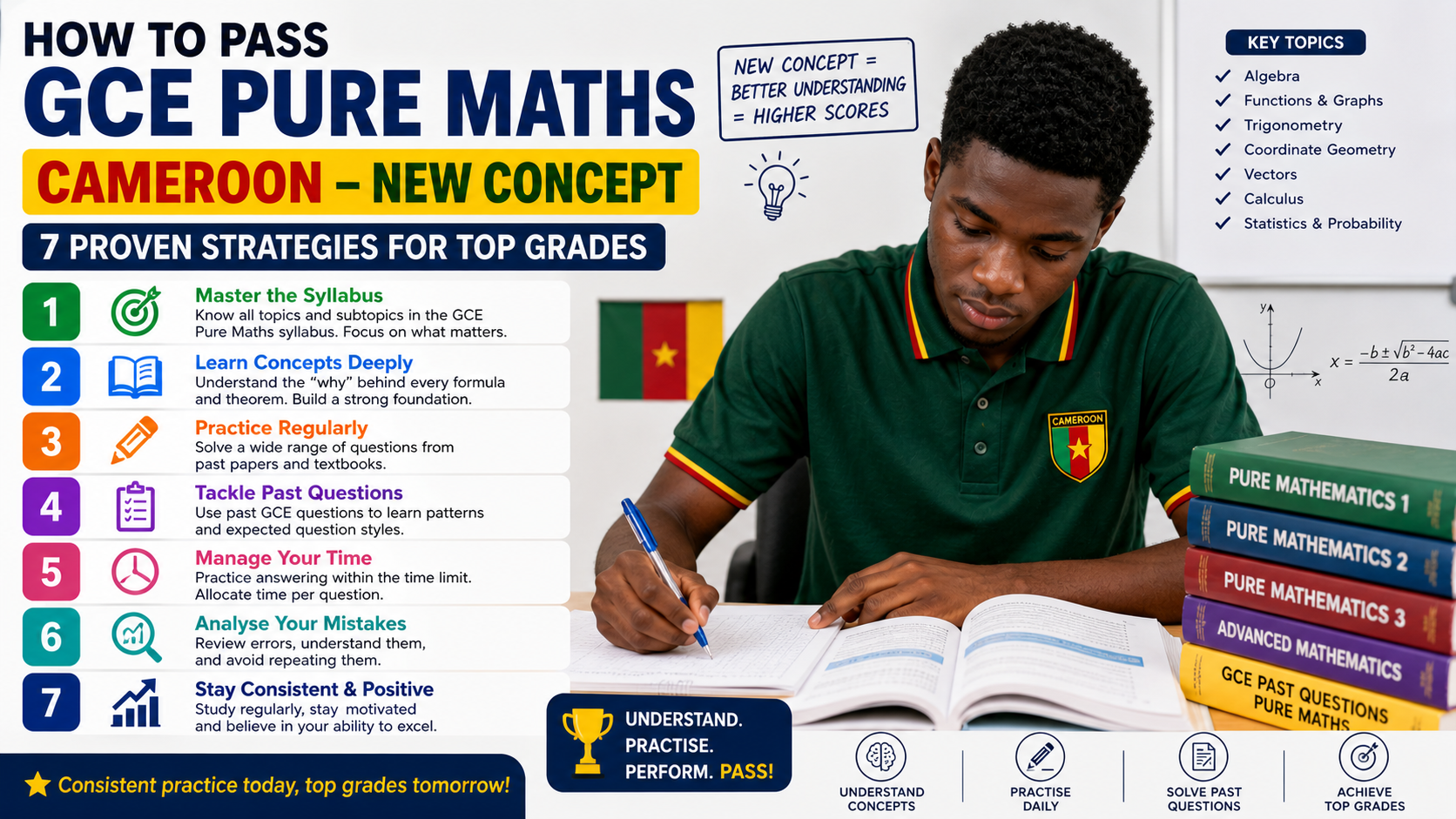
How to pass gce mathematics in Cameroon
Method 6: Avoid the Mistakes That Separate B Students from A Students
Understanding how to pass GCE Mathematics in Cameroon at the highest level requires recognising the specific errors that prevent B students from reaching A and distinction. These are the most common:
Mistake 1: Incomplete integration answers. Forgetting the constant of integration (+c) on indefinite integrals costs marks every year. It is a single character that loses a single mark but it appears on almost every integration question.
Mistake 2: Incorrect use of the chain rule. Many students correctly differentiate the outer function but forget to multiply by the derivative of the inner function. Check every chain rule calculation by identifying both the outer and inner function explicitly before differentiating.
Mistake 3: Algebraic errors in long questions. A sign error or arithmetic slip in line 2 of a long calculation propagates to every subsequent line. Check each algebraic step before proceeding. Examiners sometimes provide follow-through marks for correct method after an earlier error but only if the method remains correct.
Mistake 4: Not reading the full question. GCE Mathematics questions frequently contain specific instructions: “give your answer in exact form”, “leave your answer in terms of π”, “show that”, “hence find”. Missing these instructions produces a technically correct answer that scores no marks.
Mistake 5: Stopping at an unsimplified answer. GCE Mathematics examiners expect simplified, rationalised answers. An answer of 6/(3√2) instead of √2 loses the final accuracy mark. Always simplify surds, rationalise denominators, and express fractions in lowest terms.
Mistake 6: Cramming formulas without understanding. The GCE Mathematics examination is three hours long. Students who memorise without understanding run out of usable knowledge in the second hour. Students who understand derivations can reconstruct any formula they momentarily forget. Learn the why behind every formula, not just the what.
Frequently Asked Questions GCE Mathematics in Cameroon
What is the MAFA Mathematics Competition and how does it help GCE preparation?
The MAFA Mathematics Competition (MAFAMC) is an annual mathematics competition in Cameroon co-founded by Keng Elson of eStudyUniverse. It is designed for secondary school and university students and develops advanced problem-solving skills beyond the standard GCE syllabus. MAFA participants consistently outperform their peers in GCE Mathematics because competition-level problem solving builds the fluency and confidence that GCE distinction requires.
What topics appear most in GCE Mathematics past questions in Cameroon?
Based on GCE Mathematics past questions from 2010 to present, the most frequently examined topics in Paper 1 are integration (especially integration by parts and substitution), differentiation (chain rule, implicit and parametric), binomial expansion, trigonometric identities and equations, and coordinate geometry of circles. In Paper 2, probability distributions (binomial and normal), hypothesis testing, and Newton’s laws with connected particles appear most consistently.
Is GCE Further Mathematics harder than A Level Mathematics?
GCE Further Mathematics is significantly more advanced than A Level Mathematics. It requires complete fluency in all A Level Mathematics content as a foundation, then extends into complex numbers, matrices, advanced integration techniques, proof by induction, and further applied mathematics. Students considering Further Mathematics should be confident A Level Mathematics students and should practise Further Mathematics past questions separately. Both subject’s past questions are available free at eStudyUniverse.
Where can I download free GCE Mathematics past questions in Cameroon?
Free GCE Mathematics past questions for O Level and A Level from 2010 to present are available on eStudyUniverse. Further Mathematics past questions are also available separately. No account required for free papers. Marking guides with full worked solutions are available for premium download.
How do I pass GCE Mathematics Paper 1 Pure Mathematics?
To pass GCE Mathematics Paper 1, master calculus (differentiation and integration cover approximately 30% of marks), practise algebraic manipulation until it is fluent and fast, learn all trigonometric identities and practice applying them to simplify expressions and solve equations, and complete at least 8 timed Paper 1 practice sessions in the 10 weeks before your examination.
How long does it take to prepare for GCE Mathematics?
For students with a solid Form 4 and Lower Sixth Mathematics foundation, a structured 16-week preparation programme is sufficient to achieve distinction in GCE A Level Mathematics. For students who find Mathematics challenging, 24 weeks of structured daily practice is more realistic. The key variable is not the hours spent it is the number of problems solved under timed conditions with full working.
Download Free GCE Mathematics Past Questions
Every method in this guide is reinforced through one habit: daily practice with real GCE Mathematics past questions from the Cameroon GCE Board.
Download free GCE Mathematics past questions for O Level and A Level from 2010 to present at eStudyUniverse. Further Mathematics past questions are also available. No account required. Marking guides with full worked solutions available for premium download.
For the official GCE Mathematics syllabus and examination timetable, visit the Cameroon GCE Board official website.
Practise Mathematics on the go with offline access on the eStudyUniverse app free on the Google Play Store. The app provides adaptive Mathematics question banks, AI-powered explanations for each solution step, and answer review so you always know which topic to focus on next.
Browse all GCE subject past questions at the eStudyUniverse GCE past questions hub. Related subjects: GCE Further Mathematics past questions | GCE Physics past questions
Related: Browse free GCE past questions PDF for O Level and A Level revision on eStudyUniverse.
Free GCE Maths past papers + Practice Center


Master GCE Maths with Timed Papers
Sit Pure Maths and Mechanics papers offline, mark with solutions, and drill calculation speed in the Practice Center before the June session.
Free download · Offline mode · AI Tutor · Practice Center
Related articles: GCE Maths past questions PDF | Free GCE past questions hub | Mathematics A Level hub