
 By Cyril Kimbi
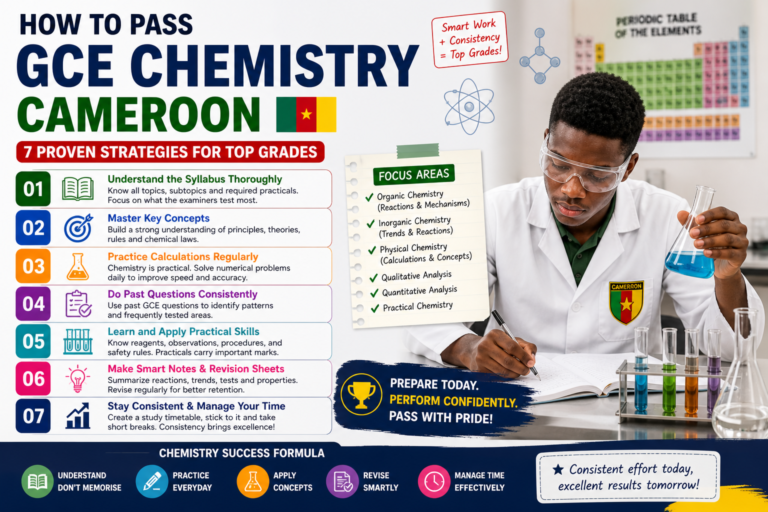
How to pass GCE Chemistry in Cameroon is the question that separates students who aim for medicine, engineering, or science at university from those who settle for a lower grade because they never found a method that worked. GCE Chemistry is simultaneously one of the most intellectually rewarding and most technically demanding A Level subjects in the Cameroon curriculum. It combines mathematical problem solving, memorisation of reaction mechanisms, practical skills, and the ability to explain chemical processes in precise scientific language.
The students who pass GCE Chemistry with distinction do not possess special talent. They possess a clear method. This guide gives you seven essential strategies drawn from analysis of GCE Chemistry past questions from 2010 to present and the teaching experience of the eStudyUniverse team.
Understanding the GCE Chemistry Examination in Cameroon
To know how to pass GCE Chemistry in Cameroon, you must understand exactly how the Cameroon GCE Board structures the examination and where the marks are distributed.
Paper 1 Multiple Choice (1 hour 15 minutes): 40 questions covering the full A Level Chemistry syllabus. Questions test recall, formula application, equation balancing, and logical deduction from chemical principles. No choice of questions.
Paper 2 Structured Questions (2 hours 30 minutes): This paper combines short calculation-based questions with longer questions requiring written chemical explanations, mechanisms, and data analysis. It is the paper that most differentiates grade boundaries.
Paper 3 Practical Paper (1 hour 30 minutes): Tests laboratory procedure, titration technique, qualitative analysis (identifying ions and gases), data recording, and experimental interpretation.
For O Level Chemistry, two theory papers and a practical component are examined. O Level covers foundational inorganic chemistry, basic organic chemistry, and introductory quantitative chemistry.
How to pass gce chemistry in Cameroon
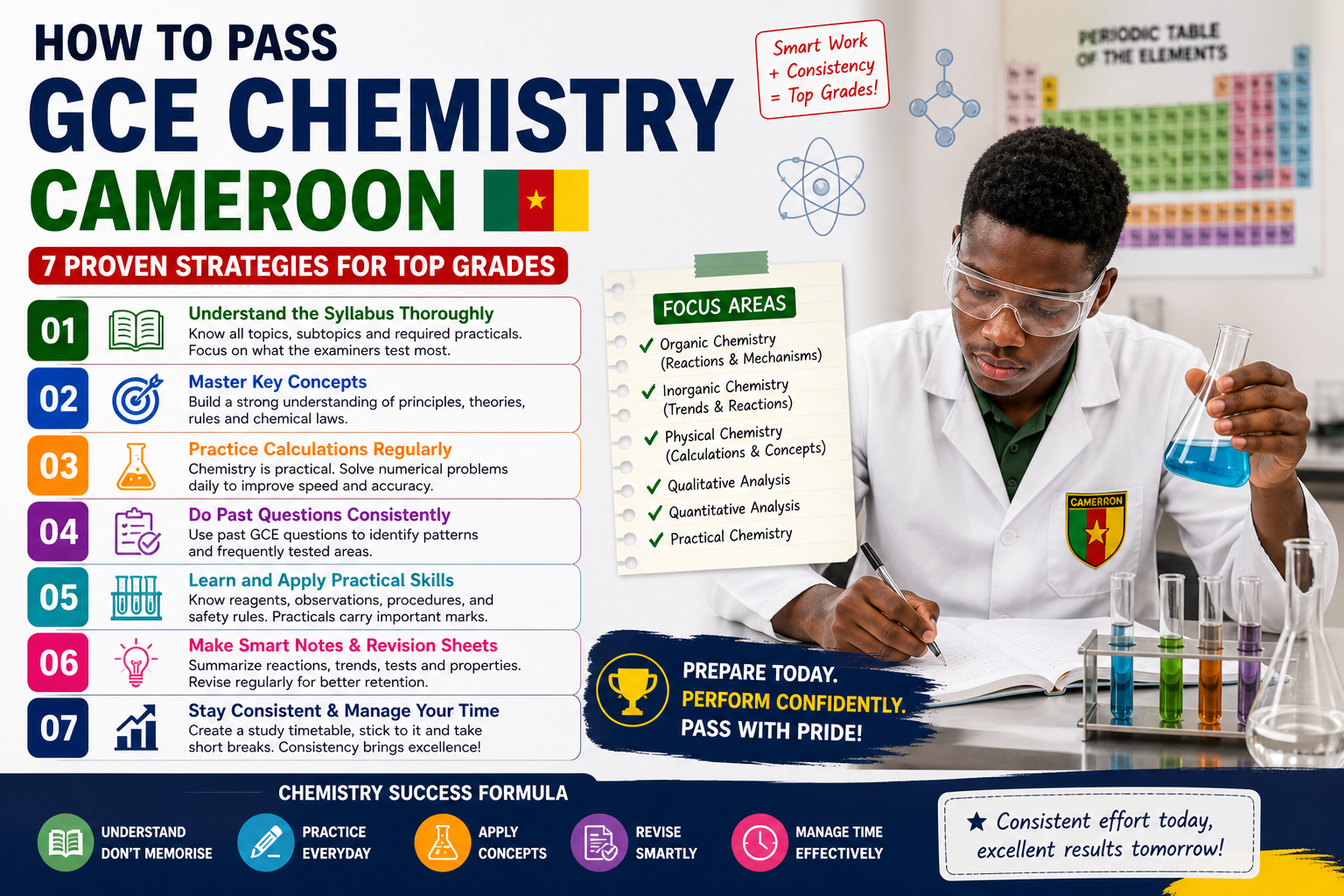
Strategy 1: Conquer the GCE Chemistry Topics That Appear Every Year
How to pass GCE Chemistry in Cameroon begins with knowing which topics the GCE Board examines every year without exception. After analysing GCE Chemistry past questions from 2010 to present, these topics appear consistently across all papers:
Inorganic Chemistry:
- Atomic structure and the periodic table (periodicity of physical and chemical properties)
- Chemical bonding (ionic, covalent, metallic, intermolecular forces and their effect on properties)
- The mole concept and stoichiometry (molar mass, empirical formula, percentage composition)
- Equilibrium (Le Chatelier’s principle, Kc and Kp expressions, industrial applications such as Haber and Contact processes)
- Electrochemistry (electrolysis, electrode reactions, electrochemical cells, standard electrode potentials)
- Reaction kinetics (rate expressions, order of reaction, activation energy, catalysis)
- Acids, bases, and buffers (pH calculations, buffer action, titration curves)
Organic Chemistry:
- Functional group identification and reactions (alkanes, alkenes, alkynes, halogenoalkanes, alcohols, aldehydes, ketones, carboxylic acids, amines, esters)
- Reaction mechanisms (free radical substitution, electrophilic addition, nucleophilic substitution, elimination)
- Organic synthesis routes (multi-step conversions between functional groups)
- Spectroscopy (mass spectrometry, infrared spectroscopy, NMR how to interpret spectra to determine structure)
Organic chemistry consistently accounts for 30 to 40% of marks across Paper 1 and Paper 2 in GCE Chemistry past questions. It is also the area where the most students lose marks due to incomplete memorisation of reaction conditions and mechanisms.
Strategy 2: Master Mole Calculations Before Anything Else
If there is one skill that underpins how to pass GCE Chemistry in Cameroon at A Level, it is confident, accurate mole calculations. Almost every quantitative question in GCE Chemistry past questions whether about stoichiometry, equilibrium constants, pH, titration, or electrode potentials requires mole concept fluency.
The hierarchy of mole calculations to master, in order:
- Molar mass calculations calculating Mr from formula, then moles from mass
- Empirical and molecular formula from percentage composition or combustion data
- Limiting reagent calculations identifying which reactant is consumed first
- Titration calculations from volume and concentration to moles and back to concentration of unknown
- Gas volume calculations using molar volume at STP and the ideal gas equation
- Equilibrium constant expressions writing Kc and Kp, calculating their values from equilibrium concentrations or pressures
- pH and Ka calculations strong acid pH, weak acid pH using Ka, buffer pH
A student who can solve all seven types quickly and accurately under pressure has secured a substantial portion of every Paper 2 they will ever sit. Practise these calculation types using questions from GCE Chemistry past questions on eStudyUniverse until each type takes less than 3 minutes.
Strategy 3: Learn Organic Chemistry Mechanisms Properly
Organic chemistry mechanisms are the single most tested topic category in GCE Chemistry Paper 2. They are also the topic that students most often partially learn they know the reactants and products but cannot write the mechanism step by step with curly arrows.
GCE Chemistry examiners award marks for each step of a mechanism:
- The correct curly arrow showing where electrons move from and to
- The correct intermediate structure (including charges)
- The correct product structure
A student who knows the mechanism step by step, with correct electron movement and intermediate structures, scores full marks on mechanism questions. A student who writes the correct starting material and final product but cannot show the mechanism scores zero or 1 mark.
The mechanisms that appear most frequently in GCE Chemistry past questions from 2010 to present:
- Free radical substitution of alkanes with halogens (initiation, propagation, termination steps with radical symbols)
- Electrophilic addition to alkenes (with HBr, Br₂, H₂SO₄/H₂O)
- Nucleophilic substitution (SN1 and SN2) of halogenoalkanes
- Elimination from halogenoalkanes to form alkenes
- Nucleophilic addition to aldehydes and ketones (with HCN, NaBH₄)
- Esterification and hydrolysis of esters
Learn each mechanism in the sequence: name → conditions → curly arrow mechanism → product. Test yourself by writing each mechanism from memory on paper. A mechanism you can only recall when you see it is not learned well enough for examination conditions.
Strategy 4: Approach Paper 2 Questions Strategically
How you manage your time and structure answers in Paper 2 determines a significant part of your final GCE Chemistry grade. Here is the strategy that works.
For calculation questions: Always write the formula first, then substitute with values and units, then calculate and state the answer with units and significant figures. If you are unsure, attempt every step you can method marks are available even when the final answer is wrong.
For “explain” questions: State the chemical principle, then apply it to the specific situation in the question. For example: “Explain why the rate of reaction increases as temperature increases.” Weak answer: “Because molecules move faster.” Strong answer: “Increasing temperature increases the average kinetic energy of molecules. A greater proportion of molecules now possess kinetic energy equal to or greater than the activation energy, so the frequency of successful collisions per unit time increases, increasing the rate of reaction.”
For “suggest” questions: These questions do not have a single correct answer they test chemical reasoning. Write a chemically logical suggestion with a brief explanation. You will receive marks for any chemically valid answer that is consistent with the information given.
Time allocation in Paper 2: Allocate time per mark approximately 1.5 minutes per mark. A 4-mark question should take around 6 minutes. A 10-mark question should take around 15 minutes. Do not exceed your allocated time on any single question move on and return if time allows.
Strategy 5: Prepare for Qualitative Analysis in Paper 3
GCE Chemistry Paper 3 has two consistent components: titration and qualitative analysis. Most students practise titration but neglect qualitative analysis and then lose the easiest and most predictable marks in the practical examination.
Qualitative analysis in GCE Chemistry Paper 3 tests your ability to identify ions and gases from their reactions with reagents. The tests you must know perfectly:
Cation tests: Flame tests (Li⁺ red, Na⁺ yellow, K⁺ lilac, Ca²⁺ brick red, Ba²⁺ green, Cu²⁺ blue-green). Precipitate tests with NaOH and NH₃ know the colour of each precipitate and whether it dissolves in excess NaOH or excess NH₃.
Anion tests: Carbonate (CO₃²⁻ effervescence with acid, CO₂ turns limewater milky), sulfate (SO₄²⁻ white precipitate with BaCl₂ in acid), halide (Cl⁻ white, Br⁻ cream, I⁻ yellow precipitate with AgNO₃), nitrate (brown ring test).
Gas tests: CO₂ turns limewater milky. NH₃ turns damp red litmus blue. Cl₂ bleaches damp litmus paper. SO₂ decolorises acidified potassium permanganate. O₂ relights a glowing splint. H₂ pops with a burning splint.
Memorise these tests in a table. Practise writing them from memory. In Paper 3, qualitative analysis questions are a predictable gift the same tests appear every year.
Strategy 6: Build Your 12-Week GCE Chemistry Study Plan
Knowing how to pass GCE Chemistry in Cameroon strategically means structuring preparation across time, not cramming in the final days.
Weeks 1 to 2: Atomic structure, bonding, and the mole concept. These are the foundation every other topic builds on them. Master mole calculations to the point where they feel automatic.
Weeks 3 to 4: Energetics, kinetics, and equilibrium. These three topics link conceptually learn them together. Master Le Chatelier’s principle and equilibrium constant calculations before Paper 2 practice.
Weeks 5 to 6: Electrochemistry, acids and bases, and pH calculations. These topics appear together in Paper 2 data questions frequently.
Weeks 7 to 8: Organic chemistry functional groups, reactions, and mechanisms. Spend more time here than anywhere else. Write every mechanism from memory daily.
Weeks 9 to 10: Full Paper 1 and Paper 2 timed practice. One complete past paper per week under strict examination conditions. Mark, review, and re-attempt wrong answers.
Weeks 11 to 12: Paper 3 preparation titration technique, qualitative analysis tests, graph drawing, and error analysis. Three dedicated practical sessions per week.
The eStudyUniverse app lets you practise GCE Chemistry questions topic by topic during the first eight weeks, then switch to full timed paper simulations in weeks 9 to 12. The AI tutor provides immediate feedback explaining why an answer is wrong and what the correct chemical reasoning is. Download it free on the Google Play Store.
Strategy 7: Avoid These Chemistry Mistakes They Cost the Most Marks
These are the specific errors that cost GCE Chemistry students marks every examination year based on analysis of past papers and mark schemes:
Mistake 1: Giving the product without the mechanism. In organic chemistry questions, the question says “give the mechanism” for a reason. Writing only the product earns zero or partial marks. Write every step.
Mistake 2: Omitting state symbols in equations. GCE Chemistry past questions reward correctly balanced equations with state symbols: (s), (l), (g), (aq). Missing state symbols cost marks even when the equation is balanced correctly.
Mistake 3: Using the wrong conditions for reactions. Saying an alkene reacts with bromine water without specifying “in the dark and at room temperature” for addition vs. “UV light” for substitution produces the wrong product and mechanism. Conditions are marks.
Mistake 4: Confusing Kc with Kp. Kc uses concentrations. Kp uses partial pressures. Writing a Kc expression with pressures, or a Kp expression with concentrations, scores zero regardless of the mathematical structure.
Mistake 5: Imprecise electrode equations. Electrode equations in electrolysis questions must be balanced for charge, atoms, and electrons. A single unbalanced electron scores zero. Check every electrode equation against atom balance, then charge balance, then electron count.
Mistake 6: Not reading the number of marks. A 1-mark question expects one precise statement. A 4-mark question expects four distinct points. Many students write extensively on 1-mark questions (wasting time) and inadequately on 4-mark questions (losing marks).
Frequently Asked Questions GCE Chemistry in Cameroon
How many papers are in GCE A Level Chemistry Cameroon?
GCE A Level Chemistry in Cameroon has three papers. Paper 1 is multiple choice covering inorganic and organic chemistry (1 hour 15 minutes). Paper 2 is structured questions including calculations, mechanisms, and data analysis (2 hours 30 minutes). Paper 3 is the practical paper covering titration, qualitative analysis, and experimental skills (1 hour 30 minutes).
What topics appear most in GCE Chemistry past questions in Cameroon?
Based on GCE Chemistry past questions from 2010 to present, the most frequently examined topics are organic reaction mechanisms (appearing in every Paper 2), mole calculations and stoichiometry, equilibrium (especially the Haber and Contact processes), electrochemistry, kinetics (rate expressions and activation energy), pH and buffer calculations, and qualitative analysis in Paper 3.
How do I pass GCE Chemistry organic chemistry questions?
To pass organic chemistry questions in GCE Chemistry, learn every reaction mechanism step by step with curly arrows not just the reactants and products. Practise writing each mechanism from memory on paper daily. Know the conditions (temperature, catalyst, solvent) for every reaction. Study how functional groups interconvert through multi-step synthesis routes, which appear regularly in Paper 2.
Where can I download free GCE Chemistry past questions in Cameroon?
Free GCE Chemistry past questions for O Level and A Level from 2010 to present are available on eStudyUniverse. No account is required for free papers. Marking guides with worked solutions are available for premium download.
What is the best way to improve GCE Chemistry calculation scores?
Improve Chemistry calculation scores by practising each calculation type mole calculations, pH, Kc, Kp, electrode potentials in isolation until each is fluent. Then practise from GCE Chemistry past questions under timed conditions. Always show every step: formula, substitution, calculation, answer with units. Method marks protect your score even when arithmetic errors occur.
Download Free GCE Chemistry Past Questions
Every strategy in this guide is most effective when paired with consistent practice using real GCE Chemistry past questions from the Cameroon GCE Board.
Download free GCE Chemistry past questions for O Level and A Level from 2010 to present at eStudyUniverse. No account required. Marking guides with full worked solutions available for premium download.
For the official GCE Chemistry syllabus, visit the Cameroon GCE Board official website.
Practise anywhere, even offline, with the eStudyUniverse app free on the Google Play Store. The app includes AI-powered explanations for organic chemistry mechanisms, topic-by-topic question banks, and performance tracking.
Browse all GCE past questions at the eStudyUniverse GCE hub. Related subjects: GCE Biology past questions | GCE Physics past questions
For GCE past questions across all subjects, visit our free GCE past questions PDF hub.
Free GCE Chemistry past papers + AI Tutor


Revise GCE Chemistry Offline
Download Chemistry annales, practise organic and inorganic topics with worked solutions, and use Region-Capture when mechanisms confuse you.
Free download · Offline mode · AI Tutor · Practice Center
Related articles: GCE Chemistry past questions | Free GCE past questions hub | Chemistry A Level hub